
Austin has been becoming one of the most vibrant technology ecosystems in the US. The city, dubbed as Silicon Hills, is a combination of startup culture, international growing tech, semiconductor manufacturing, and artificial intelligence development into one fast-moving innovation center.
Austin in recent years has been transformed into a national competitor as opposed to the emerging alternative to Silicon Valley. The combination of the activity of venture capital, corporate migrations, talent caused by universities, and infrastructure investment have continued to keep the city at the center of debate regarding the future of technology in America.
AI has been one of the most discussed topics in the tech community in Austin. Homegrown startups are developing machine learning systems, generative AI applications, automation-based cybersecurity solutions, and enterprise multinational customers using SaaS. Firms are also pouring funds in the cloud computing and scalable platform to host data intensive applications. This further growth is evidenced by the demand of AI engineers and data scientists.
Another technology that brings a lot of growth to Austin is semiconductor manufacturing. It is through Samsung sophisticated chip establishments that the region is more than competitive in the domestic semiconductor manufacturing.
As more attention is paid to the resilience of supply chains and manufacturing in the United States, Austin becomes a significant part of assisting with the national strategy of technology. Chip making, sophisticated packaging and combining AI hardware is becoming the order of the day in the business community in the area. Big firms are further entrenching their operations in the area.
The Gigafactory in Texas is still a significant workplace and production hub at Tesla, which has affected the development of automation and energy innovation. Austin has long history of enterprise technology, which is strengthened by Dell Technologies, a company that is based in neighboring Round Rock. Apple, Oracle, Google and Amazon Web Services have engineering and operations footprints that lead to cloud computing, enterprise software as well as infrastructure services.
The startup activity is still lively even in the context of the wider economic variations. Founders in other sectors continue to be supported by venture capital firms like LiveOak Venture Partners, Silverton Partners and S3 Ventures which focus on fintech, health technology, climate tech and SaaS platforms. Capital Factory continues to be a meeting point of networking, mentorship and start-up capital. The University of Texas at Austin enhances the ecosystem by providing engineering skills and facilitating research activities.
The trend on editorials indicates that there is a consistent demand of technical jobs. Software engineers, DevOps experts, cloud architectures, and cybersecurity experts are still some of the highly demanded jobs. Transforming workforces in some of the national tech companies, diversified employer base in Austin has allowed the city to remain resilient.
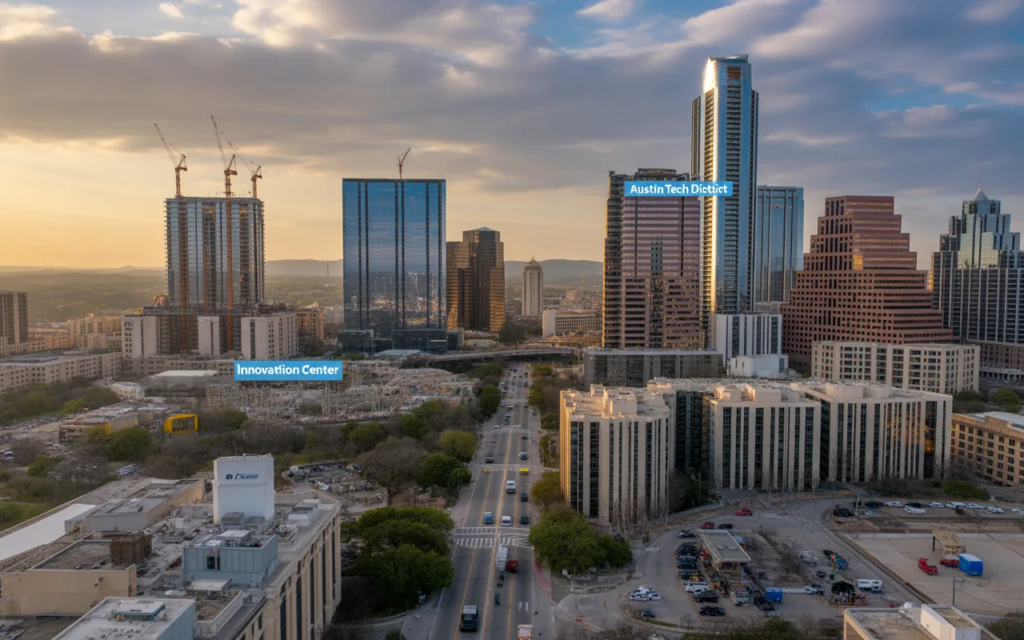
The hybrid model of work has remained typical, and companies can strike a balance between office teamwork and remoteness. Investment in data centers is still triggered by the spread of cloud computing and AI infrastructure. The high-end computing facilities demand quality energy facilities, high-speed internet connections, and flexibility to design.
The business-friendly environment in Texas such as competitive taxation has been persuading companies to increase their operations in the area. Simultaneously, the increasing energy demand and infrastructure capacity are gaining relevance in planning issues.
The real estate market in Austin is an effect of long-term expansion of technology. The business trends are centered on adaptable office areas where teamwork and creativity are attained. There has been a rise in residential demand in areas around large campuses and technology belts. The issue of housing affordability is a debated one when the professionals move to the city.
A critical factor in the development of the culture of innovation in Austin is events and conferences. SXSW still hosts technology giants, investors and creators around the world and can be seen as a ramp-launchpad in other cases where new products are announced or startups are exposed.
Other industry conferences, Demo days, and AI-specific events intensify networking and assist founders to meet venture capital firms. Observing the good momentum, there are still some challenges. The high rate of population growth causes strain on transportation, utilities and houses. Other emerging tech centers are competing with Austin, which requires it to keep on investing in infrastructure and talent management.
The branding of the city as Silicon Hills is now no longer a branding exercise. It is an increasing importance of startup spirit, corporate funds, high-technology production, and innovations based on research. Every time there is new money announced, or a hiring spurt, or a review of infrastructure building, Austin is on the list of the most actively monitored technological markets in the United States.
Conclusion
Austin technology industry is still developing by incorporating the triplets of startup innovation, semiconductor investment, AI infrastructure development, and corporate expansion. Silicon Hills has grown to be an important ecosystem in the country with a combination of advanced manufacturing, as well as innovative software development.
With the future of the global economy being influenced by the emergence of artificial intelligence, cloud computing, and the manufacturing of chips, Austin will continue to be one city to monitor. Opportunity and responsibility are represented by its path as it takes time to plan long term growth to be among the top global technology centers.
FAQs
Why is Austin considered a major tech hub?
Austin has a combination of vigorous venture capital activity, skilled labor force given by the University of Texas, corporate expansions and business friendly policies which favour innovation.
Which industries are driving Austin’s tech growth?
The most popular areas include artificial intelligence, semiconductor manufacturing, cloud computing, cybersecurity, SaaS platforms and clean energy technology.
Are companies still relocating to Austin?
Relocations and expansions do persist, of course, as companies are interested in the flexibility in operations, economies of scale, and availability of technical skills.
How important is semiconductor manufacturing to Austin?
The manufacturing of semiconductors, especially in the facilities of Samsung, reinforces the supply of national chips and boosts the development of AI hardware.
What types of tech jobs are in demand in Austin?
Some of the most in demand jobs include software engineers, AI experts, cloud architects, DevOps experts, and cybersecurity experts.
How does Austin compare to Silicon Valley?
Smaller than major cities, Austin has competitive prices, expanded venture capital backing, as well as a cooperative startup cultur
Is Austin’s tech growth sustainable long term?
The infrastructure growth, energy security, housing affordability, further investment in education and workforce development will be the areas that the sustainability will rely on.
Author

aqssa566@gmail.com