
AI can assist industries to be more productive, have fewer machine breakdowns, and have better products. It also assists human workers to perform complicated workloads and allows completing more and safer and efficient work.
What Is AI in Industrial Automation?
The concept of industrial automation AI can be defined as the incorporation of AI-based technologies (including machine learning, computer vision, intelligent robotics, etc.) into machines and systems to render them smarter. These systems can learn with the help of the data, decide and change themselves automatically without human participation.
Unlike traditional automation systems that follow the steps and rules, AI based systems can change with the changing conditions in real time. They can recognize issues, foresee machine breakdowns and best plan production without the need to have someone who takes charge of this.
Ai-enabled industrial systems are flexibleized and made efficient through AI. Machines can also improve the quality of the product, reduce the downtimes, and use the energy more productively. Overall, AI is employed to ensure industries are more intelligent, quicker, and dependable.
Industrial Automation Landscape
The industrial automation with ai is evolving rapidly with corporations employing smarter technologies to perform their work more effectively. Industry 4.0 is making the factories interconnected, where machines and software automatically collaborate with each other.
AI is finding applications in the manufacturing, logistics, and electronic field to enhance production, minimize error, and time wastage. Machines are able to foresee issues, examine quality, and handle jobs automatically.
Governments cue this development by providing programs, funds, and policies to incentivize business to apply AI and experiment with novel technologies. This assists in building a firm innovative environment.
How AI in Industrial Automation Works
Industrial automation artificial intelligence begins with a collection of data on machines through sensors and IoT devices. Such sensors monitor aspects such as temperature, speed and machine performance.
The data is then subjected to AI models or machine learning and deep learning models, which process patterns and reach decisions. These models assist machines to learn previous practices and advance as time goes by.
Factories can monitor the workflow, anticipate potential equipment failure, and automate production under AI. This helps in reducing downtimes, increased efficiency and improvement on the quality of the industrial processes.
Benefits of AI Technologies Powering Industrial Automation
Machine Learning
Machine learning helps the machines to predict the potential failure of equipment. AI can predict the maintenance according to sensor data and this plan before something goes wrong and reduce the downtime and money used on maintenance.
Computer Vision for Quality Control
Computer vision enables a machine to check and automatically see the product to identify faults. With AI-driven inspection systems, quality control becomes more efficient and reliable since it is more accurate and consistent.
Digital Twins and Simulation
Digital twins are dummy representations of the factory or production process. They enable a business to experiment with changes and optimize processes, as well as decrease risks without the need to influence the actual operations.
Collaborative Robotics and AI
Cobots are safe in how they interact with individuals. The AI also makes such robots adaptable and sure, helping the team to handle the work more efficiently and increasing the safety of the manufacturing floor.
Agentic AI in Industrial Automation
AI that is agentic can be defined as intelligent systems that are able to be autonomous, make independent decisions. In contrast to ordinary AI, which just serves human beings or acts according to pre-determined rules, agentic AI is able to analyze a situation, design actions, and modify operations without requiring human assistance on a regular basis. These systems are also meant to streamline processes in a continuous manner and make it more efficient as well as minimising errors in real time.
In industrial automation, agentic AI is applied to control self-optimizing production lines, to control scheduling, to react to equipment faults, and to adjust the processes according to changing conditions. Examples of such include an agentic AI system that will automatically modify machine settings to stay within quality, reroute workflows in case a problem arises and also meet production goals with minimal downtime.
Generative AI in Industrial Automation
Generative AI is used to create and optimize industrial workflows and production simulations. It can propose new methods of carrying out operations, minimizing wastages, and maximizing efficiency without necessarily involving people as the main source of information. This is faster and more precise in planning and designing processes.
Generative AI also facilitates operators who have natural language interfaces so that they can communicate with machines effortlessly. It will be able to automate documentation, develop standard operating procedures (SOPs), and develop reports, which will save time and errors in industrial processes.
Edge AI in Industrial Automation
Edge AI This is an approach where artificial intelligence is executed on the machine or local device rather than transferred to the cloud. This enables factories to take real time decisions at machine level which enhances responsiveness and minimizes delays.
Edge AI also increases data security and minimizes the use of internet connectivity as data is processed on the device. It is more fast-acting and less latent than cloud-based AI, and it is also able to control sensitive industry information at a higher rate of performance as opposed to cloud-based AI even under production settings
AI in Manufacturing
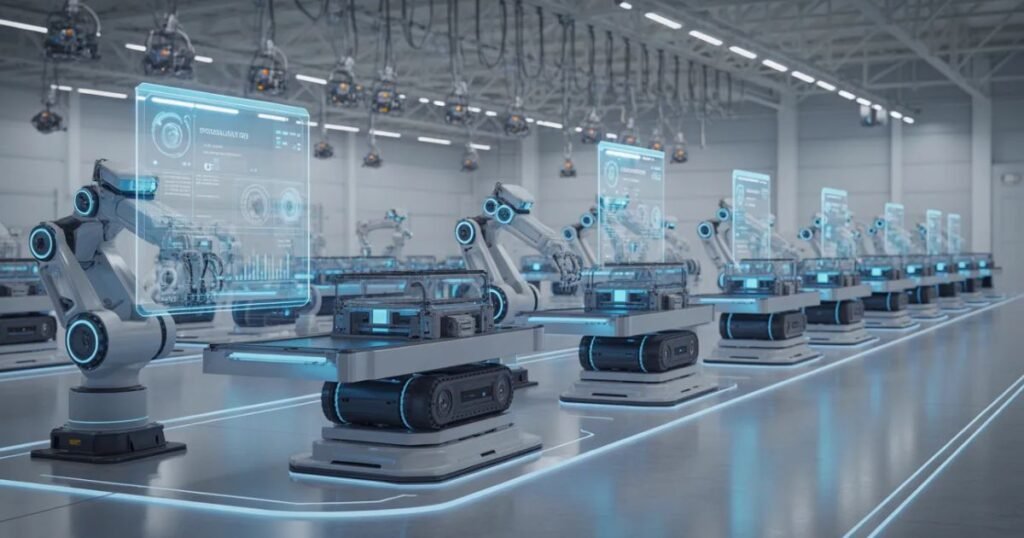
AI is changing the manufacturing industry because it is possible to create smart factories with machines and systems that can function with minimum human input and even fully automated in so-called Lights-out facilities. These intelligent systems are able to track production instantly and modify processes to be efficient.
AI is also useful in optimization of yields and cost cutting by forecasting problems, minimising waste, and scheduling production in a more efficient way. In production planning that is based on AI, manufacturers will be able to satisfy demand more quickly, enhance the quality of products, and conduct operations more effectively.
AI in Supply Chain and Logistics
AI is changing the supply chain and logistics as it is changing the accuracy with which the demand is predicted and thereby the companies anticipate the demand of what products are needed and when. It is also better at inventory management through optimization of the level of stock, decrease in waste, and elimination of shortages.
The AI also contributes to the automation of the warehouse as robots and smart systems can collect, package, and transport goods effectively. This will result in accelerated delivery, reduced operation expenses and smooth logistics operations.
Ai for industrial automation Market
Industrial automation AI is a booming market in the global market. The industries are putting money in AI with the aim of enhancing efficiency, lowering costs, and promoting productivity. There has been excellent market growth, particularly in Asia-Pacific, due to the use of the technology and its growing use.
The major drivers to this growth are: the need to have smarter factories, predictive maintenance and automated quality control. With the availability of AI, industries will have an opportunity to increase the application in manufacturing, logistics, and other industrial fields.
AI in Industrial Automation Course
Industrial automation AI upskilling is now becoming a necessity among the workers. Introducing AI technologies to the workers will aid in learning the skills on how to operate and manage the smart systems.
The courses that are most popular are machine learning, robotics, computer vision and process optimization. These are the competencies that will help the professionals to work in intelligent factories, predictive maintenance and AI operations in the future so that they would be competitive in the evolving industrial environment.
The Future of AI in Industrial Automation (2026–2030 Outlook)
Autonomous factories will become the future of industrial automation because machines and AI systems will control most tasks with minimum human intervention. It is anticipated that agentic AI will take over and decisions in real-time, production optimization, and self-correcting processes without requiring human intervention will be a reality.
The collaboration between humans and AI will also develop, where AI will facilitate the workers in daily complicated activities, making them more efficient, safe, and productive. There is an early adoption of AI in the companies, which will help them establish a competitive edge, empower sustainable growth, and create a robust industrial foundation.
Author

aqssa566@gmail.com
Related Posts
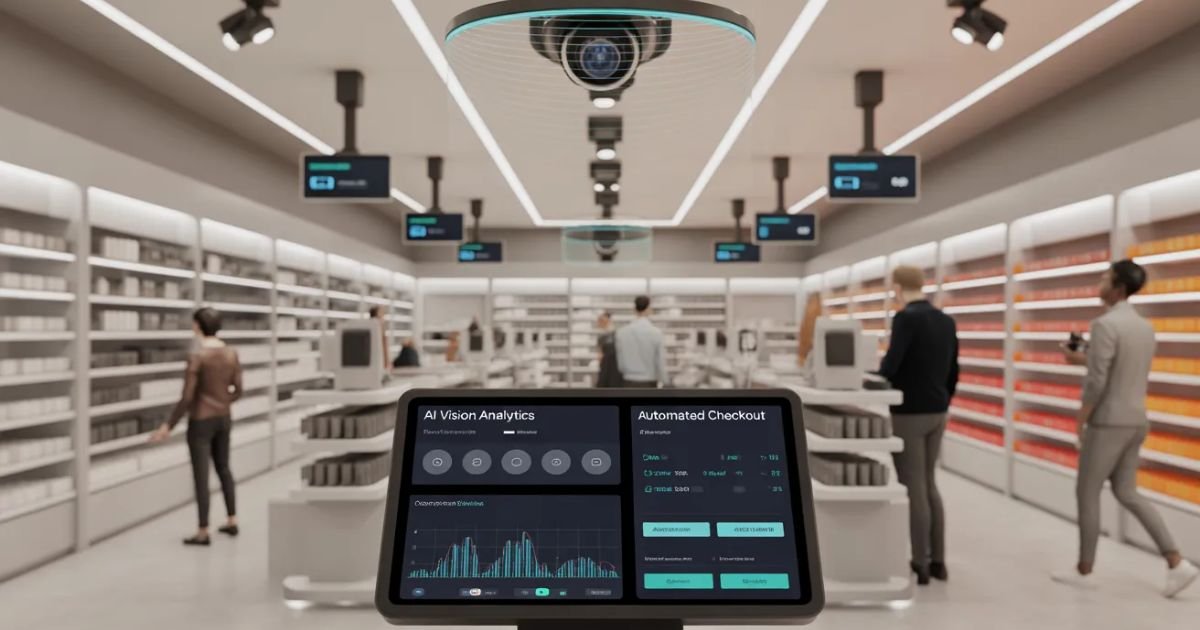
How is Retail AI Vision Automation works, Applications, Benefits, Complete Guide 2026
AI vision automation in retail helps stores see what is happening inside in real time, which was difficult to track before. Intelligent...
Read out all